

Accepting what you have today rather than aspiring to what
you don’t have is for some stifling ambition and progress. Our human spirit is
designed to challenge the status quo and to seek to evolve. But at times we also value familiarity. Runners are often rooted in entrenched habits
that perhaps for some, ease the demands of running and for others, are a secret
ingredient for potential performance excellence. So think of that quirky running-kaki that must
wear her favourite socks on competition day; follow the same pre-event routines
and meal plans; run the same training routes or be specific about the order he uses
safety pins to attach a race number to his lucky running vest.
Being Present, Being Honest
Your “Present” is your starting point. Your next run, or thoughts about your next
run are what you can control. What is
immediately within reach is how you approach that run; how you appreciate the
prospect of that next run; how you may understand the context of that run and
its impact on your future are opportunities to engage in your “Present.” That your future comes from the present and
your future is linked to how you see your “Present” may seem glib and obvious. But by taking for granted that your present
engagement is actually rooted in your history can build a barrier to
performance improvement.
Can your present view of yourself be more accepting? Is your dashboard of current performance
measures complete? What else can you understand
about where your stand in your relationship with running today that may in fact
be a moderator of your enjoyment, your attitude and your biases to how you can
and should approach your next run?
Instead of dwelling on what you think you can be in the
future, embrace yourself as you are.
Accepting the Present as your starting point is committing to your
reality. It’s viewing your running
dashboard and being honest with what stage you are at in your current running
cycle and being candid about your running fears.
Faster, Higher, Stronger!

“Coaching” at a junior level is often rooted in soft foundations where community minded volunteers are well intentioned and keen to bring knowledge and guidance to aspiring young sports lovers. Junior sport, and thus our first experiences with pastimes, games and organised sport is often initially casual, unstructured and informal. Our perceptions of what sport and competing can bring is possibly shaped deeply from our initial encounters where early experiences can leave indelible marks on our views on performance achievement.
Consider the volunteer parents that oversee training and
team management, selection and substitutions. Whether it is under 6’s football,
junior netball or deciding the doubles combination in a junior tennis match,
the desire to seek a winning combination is understandable, forgivable and fundamentally
human.
“The important thing in life is not the triumph, but the fight; the essential thing is not to have won, but to have fought well.”
- The Olympic Creed
Contrast this with the spirit of the Modern Olympics. Whilst “Citius, Altius, Fortius!” was chosen
to embody the achievements of the individual competitor, the national adulation
given to any medalist that brings pride to their country remains a focal point. Subsequent sponsorships and the associated billboard
ads, TV commercials and Instagram followers are reminders that we all love a
winner.
The balance between getting a return on the sporting dollar
spent at a national, varsity, team or even family budget level and being
reminded of the wider reasons for participation can however sometimes be forgotten
in our results orientated society where merit, adulation and success are linked
with ranked achievement. Our forgetfulness about the joys of participation can leave
a threatening cloud hovering over our expectations, and fearful of missing
targets.
Internal Possibilities
Dealing directly with our fears is for many a daunting road
and so emphasizing our strengths is often easier, requires less thinking and so
becomes our preferred approach. Confronting
one’s fears takes energy. To seek out
and acknowledge openly our fears and doubts is to highlight our shortcomings,
our perceived weaknesses and vulnerabilities.
It demands that we are honest about having perhaps wasted past efforts;
that we didn’t listen or absorb lessons and examples from knowledgeable peers
and coaches.

Our competitive society embraces success stories. We see winners as role models and perhaps our
deeper primal tendencies automatically praise speed, strength and
end-product. Thus replace ‘hunting and
gathering’ deliverables with personal records, medals, finisher tee-shirts and
souvenir pictures. The focus our parents
may have had on classroom milestones in our early school years perhaps seeped
into the annual sports day, where their secret hope was for a medal finish,
even in the egg-and-spoon novelty race.
The increased adoption to broad community themes such as diversity & inclusion, personalisation and self-managed goal setting has been a clear recent theme filtering perhaps between dressing rooms and boardrooms as leaders and individuals seek a winning edge. Advances in personal development best practices has been one clear spill over effect of a confluence of innovation domains in sport, echoing the benefits of cross domain knowledge (e.g. sports psychology and sports science) and the advent of technology (allowing for data collection and processing) to give instant personal insights on incremental improvement possibilities.
Beyond Classification
Runners perhaps understand the realities of aiming for
incremental improvement targets better than many boardroom executives, with the
fussing over minute details around training plans, clothing options, shoelace tying
systems and pre-race dietary preparation all being a standard part of any
holistic approach to performance improvement.
Runners can and often like to be categorised. Seasoned runners expect categorisation. We
can have elite categories who start at the front and set the pace; the talented
juniors; the mid-pack grinders; the steady improvers; and the costumed socialisers
that mix fun with fitness. We also accept
age and sex categories in competitive community runs. Often, we prefer more categories as is the
case with Masters racing. As a sport, we
further segment into distance specialisations – the sprinter; the mid-distance
masochist; the distance mavens; the trail adventurers and the ultra-warriors. Whilst categorising can perhaps even-out the
field so performance can be more appropriately measured, the act of measurement
and comparison results in a bias towards perceived measures for success,
minimum expectations and standards.
The mindset of a new athlete is best when it is positive and
open to acquiring new skills. Often new or anointed coaches wish to build their
credentials and so seek to impact quickly.
Creating value-add and seeking out rough diamonds in a new season should
they be lucky enough to be given a coaching responsibility can become an
understandable short-term goal.
Our Inner Coach

A focus on our fears and missing targets is an under
explored area that can yield powerful insights to impact our growth as runners. We all can easily access strength-based
coaching philosophies and off-the shelf digital content and training plans
highlighting victories and personal bests, but a personalised and introspective
analysis of our fears about our running goals is for some, an unexplored source
of improvement.
To focus on one’s deep-seated fears is a novel (and proven)
strategy in the wider performance improvement domain. The entrepreneur and lifestyle guru Tim
Ferriss pioneered the idea of “fear setting” and using it as a tool to confront
your biases. “Fear-setting” is a general
tool that Ferriss has popularised, applying it to business, personal and
general decisions. The application to running is equally appropriate, noting
Ferriss, a serious weightlifter, also applies the methodology to his athletic
pursuits.
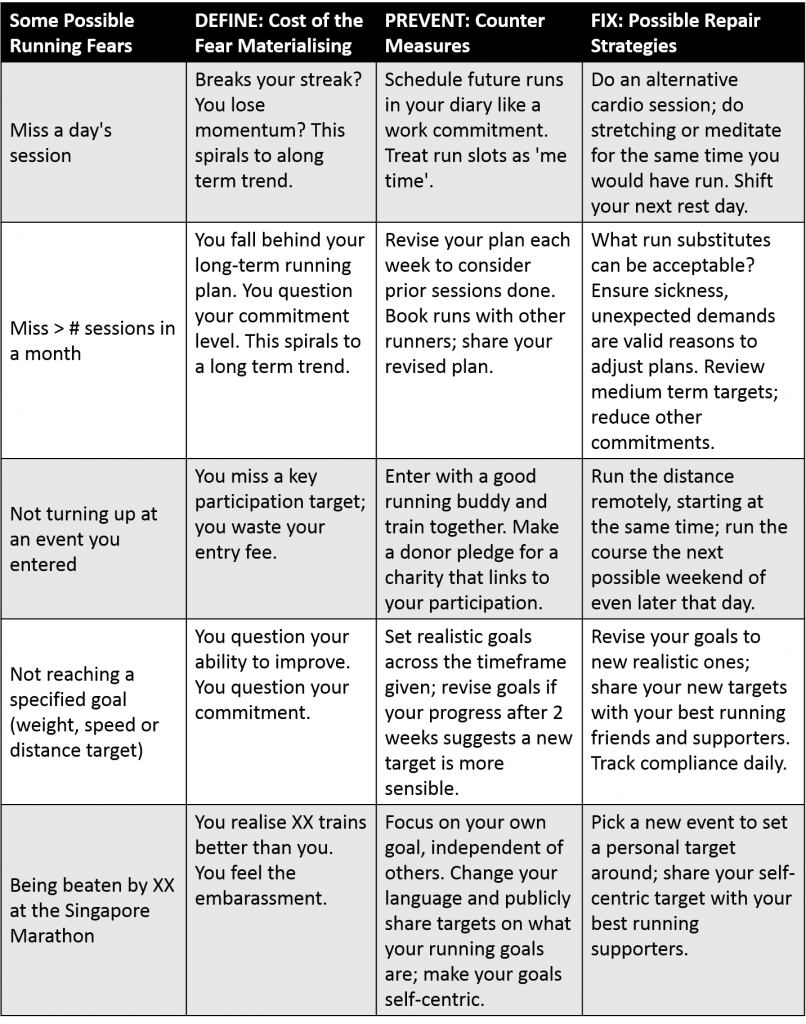
Following below is an example of applying this
process-approach to surveyed responses from some RUN Singapore readers. Consider your own running fears and do your
own “fear-setting” against the reality of your current running dashboard. Be
honest with what your running fears may be. Document ideas on how to prevent
the fears materialising and if they do, then have your ‘fixes’ ready.
By honestly identifying your fears about running and your
running goals, you allow them to be acknowledged. By documenting these fears and your prevention
and remediation plan should they materialise, your internal self can be that
coach you always wanted – one that understands your depths, your history and champions
your future authentically.
Self-coaching Questions to Manage Fear in Running
Diagnosis:
- How wide is the gap between your expected performance and actual performance?
- What is the gap in percentage terms?
- How do you feel about the performance gap?
- Why are you disappointed with a performance/race/session?
- What is a realistic timeframe to address the performance gap?
Remediation:
- What factors were outside your control that
influenced your performance? - What key remediation steps can you think of to
address the gap? - If a fear does eventuate, how can you look at that
occurrence positively? - What options exist in dealing with fears that
become a reality? - How can this current and new understanding of
your performance shortfall gap help you revise your specific goals?
Principles:
- Learn from every run about the inner you. What can you learn from your most recent running experience?
- Today represents your starting point. Each run is within your control; history and external forces cannot influence your running experience.
Further Reading
- Tools of Titans: The Tactics, Routines, and
Habits of Billionaires, Icons, and World-Class Performers. Tim Ferriss (2016) - Handbook of Competence and Motivation. Andrew J.
Elliot, Carol S. Dweck (2005) - The Inner Game of Tennis. Tim Gallwey (1974)